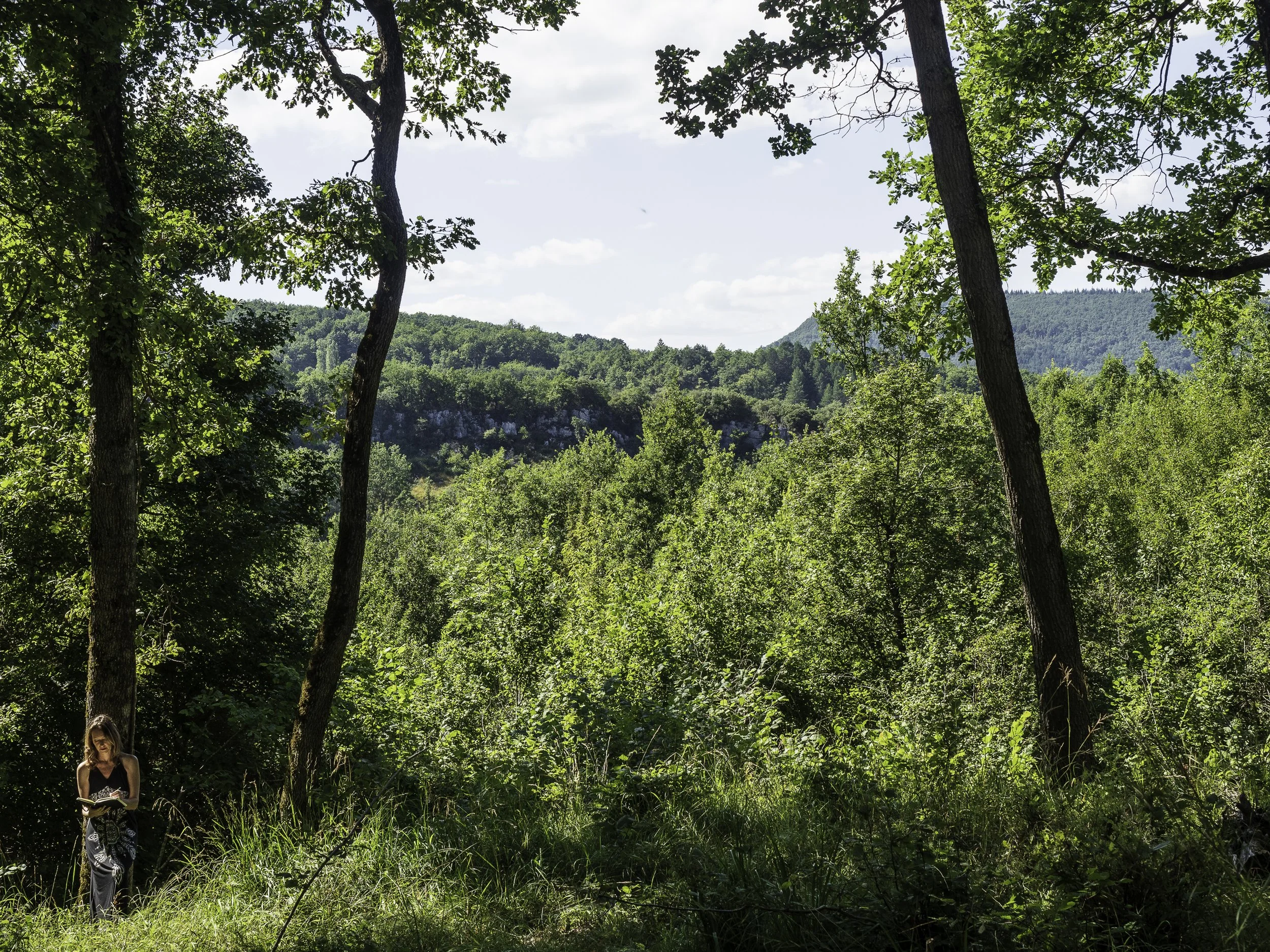
From acorn to great oak

I find that dusting down the alarm clock, and waking into the cold, dark January mornings, can be something of a shock after the Christmas hiatus.

And yet, ironically, this time of little motivation is often when we set up the highest expectations for ourselves. Diving in with gusto on the first Monday after the New Year, we determine that, in 2015, we will finish the book, attract the agent, or win the Pulitzer Prize. This will be the year where, on a personal and professional level, it ALL comes together. And yes, it will all come together, but only if we first forgive what we perceive as our past writing ‘failures’.

Creative writing is one of the many tools that we have for processing emotion, re-setting the nervous system, and rehearsing life scenarios.

If it wasn’t prioritised, it’s because something else needed urgent attention, or we were using another tool of expression.  Either way, our ‘wild writer’, that evolutionary animal at the core of our being, was doing exactly what it needed to do in any given moment. And if what came out on the page was in a different voice, on a different subject, or differed in genre from what we hoped, well, perhaps it’s time to question our expectations.

How can we learn to go with the flow, rather than against it?

Learning to write well is most helpfully viewed not as a set of failures on the page to be fixed, nor as a quest to find the source of our childhood ‘problems’ in order to clear them away and reveal the great writer. These approaches just pathologise and reduce us. Instead, I propound an expansionist view of writing.

Image Credit: http://www.sweetwilliamprints.com.au/

Image Credit: http://www.sweetwilliamprints.com.au/

I visualise for a moment that I am a small acorn.

Myself and my writing project are like that acorn, pre-programmed with everything we need to grow into a magnificent oak. If I support and allow the process. I will cradle this expansive view of life; it flies in the face of those who would reduce me (and all of us) to what happened once upon a time when we were five.


Wild or crazy?

As a psychotherapist I’ve worked in hospitals for people sectioned for serious crimes, and written the start of a novel, ‘Phoenix: Supersensitive’, based around that.

My fellow tutor at Swanwick Writers’ Summer School this year was Simon Hall, the BBC’s crime correspondent for the South West, and author of ‘The TV Detective’ novels. We’ve both been on the crime front line.  Fertile ground, I felt, for a discussion about the ‘wild’ in our characters (and in ourselves for that matter). Simon has this to say about wildness in character…

For crime writers, wildness is particularly important. Whether it’s the momentary loss of control, or the long held dissociation from the world that leads to the breaching of society’s conventions…. And there’s wildness in the good guys and girls, too. Something has to drive them to track down the baddies, often well beyond the call of duty, breaking the rules and imperilling themselves at the same time.

My experience of the world as both journalist and author makes me believe there’s wildness in us all – it’s just a question of how deeply buried, how afraid we are of letting it loose… and what the consequences might be if we do.   

He’s defining wild as the animal part of us. It resides underneath, and is often bridled by, convention.

It’s the part of ourselves that we fear, and restrain, even before society does that for us.

Looking at how it can manifest, we might say that we have good reason to fear its destructive qualities. Certainly, the patients I worked with could be said to be a case in point. Those that had strangled their children, habitually swallowed knives or set fires to their rooms, I sometimes heard described as ‘wild’.

But were they truly wild? The use of the word in that context always bothered me.

They bore little resemblance to the ‘wild’ I saw in the sleek fur of the wild cat I glimpsed when I walked in the forest on my days off. An animal in the wild often looks healthy. Cutting your stomach up, or trying to hang yourself doesn’t make you look at all well, believe me.

Certainly, in one way, my patients were ‘wild’. No differently to every human and non-human animal, their lives were a heroic mission to firstly survive, and then to thrive, enacted largely unconsciously. Often, they had survived because they told stories- stories of escape and freedom when they were trapped in unbearable situations. When things were about as bad as they could get, it was that so-called ‘primitive’ part of themselves that had led them out.

However, in the case of my patients, often the strategies that had once enabled them to survive, had become outdated, inflexible or stuck.

The ‘wildness’ had become corrupted into ‘craziness’, a disconnection from reality, rather than a working in harmony with it.

Most of us, thankfully, never have to resort to the types of extreme actions that Simon or I observe in our work, or fictionalise on the page. However, we all have a journey to do to re-find our wild writer. We’re aiming at connection and balance, rather than disconnection. Then, rather than getting lost in our stories, we’ll get found through them. When we can locate true wildness in ourselves, we’re a damn sight more likely to be able to write that riveting, emotionally charged way of being on to the page.

Write a character sketch or short story piece about a character that has to respond to extreme circumstances (a threat to their physical or emotional life) with extreme actions.

You might also like to think about how these events might echo through their life afterwards, and impact upon it.

Washerwoman's Fingers

On Friday, after a hard day, I took a shower, a long shower, to unwind. The spraying water and lavender gel didn’t succeed in completely draining away the day’s tension. But my interest in something else did.

I noticed the tips of my fingers whiten, and then crease and wrinkle under the jet of water. Nothing unusual in that of course. But on Friday, I was mesmerised, because I ‘d just read a fascinating article.

The essence of the article was that wrinkled fingers give a better grip in wet conditions, and that therefore, our ‘washerwoman’s’ fingers’ –and toes for that matter, may be an evolutionary trait designed to help us to survive. The wrinkles would have enabled our ancestors to get a better footing on slippery surfaces when it rained. We’d have been able to gather food from wet vegetation or streams.

In the shower on Friday, I re-connected with my animal nature. I imagined I made my escape. I scaled the walls of that cubicle like Spiderman, and found a route up through the attic until I hit the sharp chill of the night air. I scuttled over tiled roofs, under the starred sky. I kept going until I found my way back to the space and freedom of the forest.

It was that rather unlikely imaginative leap that cleared the stresses of the day. Nothing else.

INTO THE DARKNESS PART 2

I'm on a quest to connect with the untamed world, release the wild words, and discover the wild self. Continued from last week…

I strode for twenty minutes along the unmade road that leads straight into the damp crevice of the gorge, under the shadow of the mountain.

My clicking, grinding thoughts, that inner film, continued to roll. And it was a horror film. There were men in balaclavas, drunken gangs of youths, wild boar, and hungry bears. They whooped and snarled and shrieked their war cries as they came at me from the dark places. I covered my ears with my hands and screamed.

At that moment, quite suddenly, the fears released like smoke into the air, and the film flickered to a stop. I was left alone in the night. Now I saw different things. I saw one small star signal from behind a cloud. I heard the night bird resume its comforting call. I heard the rustle of a small creature in the undergrowth, seeking a warm place for the night.

And now. It was another of Byron’s poems ‘She Walks In Beauty’, that came to mind, his description of a night of ‘cloudless climes and starry skies’.

And I remembered Mary Oliver’s work. She describes the coming of the light after ‘Sleeping In The Forest’,

‘By morning 

I had vanished at least a dozen times 

into something better.’

I realised that my days are always full and light, sometimes too bright. My eyes get tired from seeing too much. Now I was bathing in the pleasure of the restful dark, the silence and the stillness. And had it not been so cold, I might have sat down to enjoy the presence of the absence, in which all felt possible.

When I returned to the house later that night, I felt the strength of a true warrior, and slept with the contentment of someone who feels truly safe. There is nothing so fortifying as refusing to run away in the face of fear. 

Into the Darkness

Last night, late, I went and stood outside. I hoped to be exhilarated under a canopy of stars, but instead I was met by thick-hanging cloud. The sliver of the waxing crescent that was the moon, gave out little light, and my heart sank. Without a visual anchor my body and mind flailed, disoriented by the all-consuming darkness. My hand reached out, and I found the gravelly exterior wall of the house.

I thought of Byron’s poem ‘Darkness’ in which he dreams,

‘The bright sun was extinguish'd, and the stars

Did wander darkling in the eternal space’

My other senses swiftly moved in to stabilise me. I heard the river rushing about its secret midnight business. An owl hooted. The clouds deadened each noise that arose, and I was acutely aware of the silence, the stillness, and the absence. Strangely, for being in such a vast space, I felt short of air, as if I was locked in a broom cupboard. Fear swept in, bringing terror of what I couldn’t see, of what might come at me from the shadows of the bushes.

On the blank canvas of the night, the fears that had arisen and fallen during a difficult day found an exit point. It was not unlike a film set in motion. My thoughts clicked and ground their way out, as if from an antiquated cinema projector. I watched as the flickering images were cast on to the night.

The editor I hadn’t managed to please during the day was re-imagined as a poisonous snake falling from the tree above. The writing deadline I had missed was re-cast as the bloodthirsty hands of the ivy that I felt stretching for my legs. The corrupted computer software was re-invented as the antlers of a rabid stag that I thought I saw in the shadows.

However, I know from experience that it is better, whenever possible, to move towards fear rather than run away and let it chase me. I sensed also, last night, that there was something quite important about watching as my fears played themselves out.

So, I reminded myself of what I believe, that provided I respect her, nature will nourish and take care of me. Then, I set off to go for a walk into the darkness…

I strode for twenty minutes along the unmade road that leads straight into the damp crevice of the gorge, under the shadow of the mountain.

My clicking, grinding thoughts, that inner film, continued to roll. And it was a horror film. There were men in balaclavas, drunken gangs of youths, wild boar, and hungry bears. They whooped and snarled and shrieked their war cries as they came at me from the dark places. I covered my ears with my hands and screamed.

At that moment, quite suddenly, the fears released like smoke into the air, and the film flickered to a stop. I was left alone in the night. Now I saw different things. I saw one small star signal from behind a cloud. I heard the night bird resume its comforting call. I heard the rustle of a small creature in the undergrowth, seeking a warm place for the night.

And now. It was another of Byron’s poems ‘She Walks In Beauty’, that came to mind, his description of a night of ‘cloudless climes and starry skies’.

And I remembered Mary Oliver’s work. She describes the coming of the light after ‘Sleeping In The Forest’,

‘By morning 

I had vanished at least a dozen times 

into something better.’

I realised that my days are always full and light, sometimes too bright. My eyes get tired from seeing too much. Now I was bathing in the pleasure of the restful dark, the silence and the stillness. And had it not been so cold, I might have sat down to enjoy the presence of the absence, in which all felt possible.

When I returned to the house later that night, I felt the strength of a true warrior, and slept with the contentment of someone who feels truly safe. There is nothing so fortifying as refusing to run away in the face of fear. 

The Trampoline

  Tired of staring at the computer screen, I decide I should practice what I preach. I put my coat on, and carrying my empty teacup for comfort, I take my notebook out into the garden. I will write something. There’s a broken trampoline, rusted into the ground. It has a surface like black oil, and a lopsided gait. I scramble up, and sit in the centre of the almost-circle.

The last of the precious winter sun is weak on my face. Falling, falling…now clipping the top of the mountain. The river gushes. The air is sharp on my cheek. The hungry howls of the hunting dogs in the kennels on the mountainside are ghosts in the cold air. The church bells chime, their intonation definitively French.  My body tremors, physical energy trapped by too much static work. And the sun keeps falling. I have terror of the loss of the light. I think- I should write something inspiring about this, and heat rises in my chest.

But instead, I fall back on the sprung support of the trampoline, and my vision fills with the sky. A uniform block of mid-blue.  It too is fading, washing out the day. I think -when the sun goes behind that mountain, there will be nothing good left in this world to write about .

But anyway, I do not want to write. I want to hurl the teacup against the encrusted metal springs and hear it smash, or perhaps jump really hard and high on this trampoline- with my shoes on. This impulse to smash and crash, I feel it dissolve in the instant of becoming. I have years of practice of not acting upon such impulses. After all, proper grown-ups do not jump on trampolines in the winter sun on a Tuesday afternoon in February, certainly not with their shoes on.

But hell, I’m going to do it, jump as high as I can before the sun is gone. The sharp outbreath, and heavy clunk of shoes striking canvas. The wheezing of springs. Cold air scrapes at my lungs. I spin and take in 360 degrees of this world. Higher and higher, the ground recedes further with every jump.  And then, quite suddenly, the sun drops like a weight and colour washes out of the world. My energy evaporates with it and I fall prone on the trampoline.

The echo of the jumping is a soft vibration that rocks me. I hear the speeding traffic. And I think, I’d better get up now and do something. A solitary black crow, heavy-winged, trudges across the vacant sky. I don’t get up. Instead I curl up foetus-like and pull my hat over my eyes. I will hide. I will sleep.

The dusk creeps in and in moments my fingers are ice pops. Soon, I believe, the river will freeze in mid gush, and I too, will petrify here. All will be silent darkness. Until the sun arrives to thaw us.


The Reasons I Write Outdoors

The reasons I write outdoors:

To to be as passionate as Anais Nin

To be as awe filled as Mary Oliver

To dream as vividly as William Blake

To look as cool in our slacks as Ernest Hemingway

To look as hip in our shades as Bruce Chatwin

And because the best way to defend from enemy fire is by tucking a moleskin notebook into the pocket over my heart. Oh yes…

Why Write Outdoors?

  Why it is that I love to write outdoors?

At first I was just desperate to unchain myself from my desk, break out of the building, and write in nature. I craved seeing something other than a computer screen. I wanted to feel the movement of the pen again, instead of just the striking of keys.

I wanted to free up the qualities of ‘wild’ in myself and my words- expressiveness, spontaneity, the untamed, the intuitive. I dreamed of becoming the writer that I’d always wanted to be. Writing begins with living.  How could I write in full colour, if I wasn’t living in full colour?

Once out there, stripped of the trappings of society, I felt I could be more honestly myself, and that my words could be more honestly themselves too. I found that surrounded by movement, my words gained a sense of movement and drama too. When I explored and went into unknown territory, my words followed hot on my tail.

The closer I looked at the minutiae of nature, in order to describe it in words, the more vivid the outdoor world became, and the more I needed to express what it, and its salvation meant to me. It’s a virtuous circle. Not only is great writing enabled by living fully and vibrantly, living is also enabled by bringing our attention to a writing subject that embodies those qualities. Picking out details of nature to describe, I saw that everything was hitched to everything else in the universe. The world was indeed in a grain of sand, and the ocean in a drop of water.

And above everything else, I love to write outdoors because it is truly the most joyous experience. In the words of American poet, E.E. Cummings, the world becomes ‘mud-luscious and puddle-wonderful’. There is no better feeling than when my words canter on the broad savannah, dive deep in the dark ocean, and swoop in the vast blue sky. 

The French Experts

Last weekend I went from my home in the foothills of the Pyrenees, into the high mountains of the neighbouring department of Ariege. I had appointments with two expert animal trackers. I wanted to learn more about ‘wildness’ in order to go deeper into my work with ‘wild words’. My first meeting was with Serge, a wiry, self -effacing man in his fifties, sporting a moustache and 70’s shades. He’s spent twenty years tracking the Pyrenean brown bear. His job is to mediate, and to try and diffuse tensions, between the bears and the local shepherds, who regard the sheep as a threat to their flocks.

My romantic images of Serge the solitary tracker, running barefoot through the forests, were quickly dispelled when I discovered that the bears are tracked via a series of cameras.  ‘This is the only way to do it’, he told me. ‘Unless you want to stay up all night’ (they are nocturnal), ‘and unless you want to risk your life’.

It’s certainly true that most of the cultures where tracking was practiced extensively are dry earth, or desert-based, aboriginal Australians being an example. Animal prints are much easier to see in sand. In your average forest, strewn with leaf litter, sticks, and leaves, tracking not an easy task.

I then met Ernest. He’s an ichnologist. That is to say, he specialises in the science of animal traces. His house is an Alladin’s cave of casts and other art works that put into solid form the wanderings of animals over our earth.

This is a man who spent three months living on a frozen lake. This is also a man who is about to take his wife and five children to spend two months in the Brazilian rainforest. I was swept up into a brave new world by his stories.

Driving home I stopped by a man-made lake. It was deserted. The tourist season hasn’t begun here yet. Walking across the volleyball court to get to the café, I saw several clear sets of tracks in the sand. During the previous night deer had skipped through. Wild boar had lugged their heavy weight across too.

I might not be up to the facing the deserts of Australia yet, but the sand-based culture of the volleyball courts of Southern France, I can do that.

Tracks

‘The earth is a manuscript, being written and unwritten every day’.

John Stokes

The responses to this quote by the participants took my breath away. People wrote, among other things, about

Everything is a track. Everything around us displays the marks of the passage of time.  Every physical, psychological and emotional influence is recorded. The tracks of tears down the face of an ageing woman. The tracks that human beings make on the earth. The tracks that our words leave behind in the hearts of others. The movement of wind and rain carves out patterns in the rock. The patterns of emotion in the human being, over time, bend and mould and shape the muscle and bone of our physical body. Even those things that we call ‘inanimate objects’ are museums of movement, energy fixed in time and space.

There are stories everywhere. I will learn to see them more clearly. And from that melting pot of myth and fable, I will create new stories, new tracks. 

The Fire

In the winter this house is heated solely by a wood-burning stove. It’s fairly labour intensive to chop logs.  And it takes commitment to keep bringing them in, to keep the fire burning through the day. But I love it. We have something alive, something wild at the centre of our world. It hisses and cracks and roars just like any other wild thing. The Beech wood, with its silvery snakeskin bark, lights easily and sizzles. The Oak, its raised bark like the tyre of a four-wheel drive truck, is frustrating slow to catch. But once it does it smolders enduringly, with an intense heat.

Like anything wild, you have to create a relationship with it, rather than impose your hurried ways upon it. In the mornings if I’m anxious, or impatient, it never catches. If I bring patience to the task it’s ablaze in an instant. There’s a real art to fire lighting. Logs need the friction with other logs to burn, but there has to be enough air between the wood for them to breathe.

At first glance the flames have the delicacy of silk, and it’s alluring. But I know better. Their licking tongue is always hungry. The memory of the terrible smell of burnt hair and skin pricks sharp in my mind.

During the day, whenever I take a break from writing, and come down from my cold office, the fire is waiting. The orange flames endlessly shape-shifting remind me of my potential for creativity.

Some days my body has rigidified into the question mark shape of the anguished writer too long at her desk. Then, those flames laugh at the inflexibility of my body, and my words. They tickle and taunt me. It shifts me from my petty concerns.

On the worst writing days I’m thickheaded and wobbly-limbed. Then they seduce me back to life, stroking my face and my back. Painfully wonderful. They know that I’ll never write well with that tension in my mind and body. After these encounters, I go back to my desk with their enchanting laughter ringing in my ears.

Back in my cold office, I ask myself: how can I lay my words side by side so that they have space to breathe, but are close enough for their friction to make my stories blaze? How can my words form shapes as endlessly varied as flames? How can I release the energy contained in those words, but not be burnt in the process, or smother them for fear of the heat?

Snowed In

  On Monday this week, I awoke and looked out of the window. There was nothing but white. I saw only the inconvenience. I would never get a car down the mountain track with that much snow. S***! That was the end of the meeting that I had booked with an animal-tracking expert for later that day. Now I would never know his secrets.

On my second look out of the window, I saw the beauty. The fresh snowfall was casting a silent spell over the land. There might be no formal tracking lesson that day, but conditions were ripe for exploration.

The snow was still falling fast, presenting me with a time capsule- a record of the few animals that had dared to leave their sheltered places in the previous half-hour. One brave deer had taken a route down the edge of the track, where the snow was lightest. There was also the hopping pencil-line print of a robin, searching for food. And cutting purposefully straight across the track- the crawling, claw-toed prints of the badger, his stomach dragging on the ground. The entrance to his sett was just there, cut into the clay soil of the mountain.

And it wasn’t only animals. At the bottom of the hill, engraved on the blank canvas of the builders’ yard car park, the swirling tracks of a van. Evidence of the driver’s difficulty, with sleep still in his eyes, of fitting himself into a narrow parking space. And the valiant post-woman had been there too, her determined prints weaving in and out of every domain.

Turning, I re-traced my own solitary path, my autobiography printed on the snow. At the places where the distance between my tracks closed sharply, I read the history of my excitement. Arriving back at the house, I saw where I’d dragged my heavy feet away from its shelter at dawn, disappointment weighing on me. Now, an hour later, I was forward on my toes, a lighter touch on the ground. I wouldn’t swap anyone else’s secrets for those I discovered myself that day. 

Wise Wild Words

Some quotations that have nudged at my shoulder, grabbed at my sleeve, or tousled my hair:

“The mind I love most must have wild places, a tangled orchard where dark damsons drop in the heavy grass, an overgrown little wood, the chance of a snake or two, a pool that nobody fathomed the depth of, and paths threaded with flowers planted by the mind.”

 Katherine Mansfield, ‘Katherine Mansfield Notebooks: Complete Edition’.


“Writing starts with living.”

 L.L. Barkat, ‘Rumors of Water: Thoughts on Creativity and Writing’.


“The artist is a translator; one who has learnt how to pass into her own language the languages gathered from stones, from birds, from dreams, from the body, from the material world, from the invisible world, from sex, from death, from love. A different language is a different reality; what is the language, the world, of stones? What is the language, the world, of birds? Of atoms? Of microbes of colours? Of air?”

 Jeanette Winterson, ‘Art Objects’


“The world is mud-luscious and puddle-wonderful.”

E.E. Cummings

The Disclaimer

I’ve employed artistic licence. I’ve removed complications and deleted repetition. I’ve given a sense of linear progress, a narrative arc to my journey. I’ve based it in one location, and focused it around one hero.

Really, this is not a ‘disclaimer’, it’s a  ‘reclaimer’ and for that matter a ‘re-finder’. I reclaim my right to free myself from the tyranny of facts. In doing this I re-find the passion and power of my original experiences and pour it into words.

10 EXPERIENCES OF WILD

The Red Admiral butterfly flitting on to my hand, and settling a moment to dust his wings. Feeling touched by magic….

The sound of the Wild Boar cracking fallen walnuts and snorting, close to the house…

The necklace of Lapis Lazuli I was given by my boyfriend. It’s silver veins sparkling like sunlight on water. Feeling loved…

The warm wind from the tropics whipping round me, caressing my skin, and spinning golden autumn leaves into a whirlwind…

Standing in the Negev desert, when there was nothing but gently undulating sand in every direction. Nothing had ever seemed so vast…

Diving into a wide river, my whole body being gently pulled and pushed by its flow, and the duck gliding serenely past…

Lying down in a wildflower meadow in the mountains of the Pyrenees, and the shock of smelling strong wild garlic…

In France, hearing a high yelp from above me. My head snapping up to see a huge golden eagle circling in the limitless sky above, eyeing me up as prey…

The delight of the moment when they delivered the new coffee table to my first house. Running my hand along the grain of the wood, and smelling pine…

Standing, awestruck, in Devon, in the dark of the night, close to the roaring sea. The waves rearing up before me at twice my height. The moonlight catching the spray that flicks, cold into my face…